Quick Facts
- Record Holder: Phoenix A* is the current heavyweight champion, estimated at 100 billion solar masses.
- Recent Discovery: Astronomers identified a new titan in the Cosmic Horseshoe galaxy with a mass of 36 billion suns in 2025.
- Size Threshold: Objects exceeding 10 billion solar masses are classified as ultramassive black holes.
- New Methodology: Gravitational lensing now allows scientists to weigh dormant giants that do not emit light.
- Growth Driver: These monsters reach their scale through billions of years of galactic cannibalism and steady gas accretion.
- Scale Comparison: A black hole like TON 618 has a diameter larger than our entire solar system.
As of 2025, the most massive black holes—known as ultramassive black holes—represent the theoretical upper limit of cosmic growth. These giants, such as Phoenix A* and the 36-billion-solar-mass discovery in the Cosmic Horseshoe, dwarf our Sun by factors of billions, representing the absolute limits of how much matter gravity can compress into a single point in space.
Defining the Giants: Supermassive vs. Ultramassive
To understand the scale of the most massive black holes, we must first redefine our sense of the word "large." For decades, the astronomical community used the term supermassive black hole to describe the engines at the centers of galaxies, ranging from millions to a few billion times the mass of our Sun. Our own Milky Way’s central resident, Sagittarius A*, falls into this category with a relatively modest mass of 4.3 million solar masses. However, as our observational technology improved, we began discovering objects that made these supermassive entities look like pebbles.
In recent years, a new classification has emerged: the ultramassive black hole. To earn this title, a black hole must cross a staggering threshold of 10 billion solar masses. These are not just slightly larger versions of their supermassive cousins; they are fundamentally different in their evolutionary history. While a standard supermassive black hole might grow by consuming gas and dust within its host galaxy, an ultramassive giant is often the product of galactic cannibalism.
Over billions of years, massive galaxies in dense clusters collide and merge. When two galaxies become one, their central black holes eventually sink toward the new common center, entering a binary dance that ends in a cataclysmic merger. This process, repeated multiple times across cosmic history, allows these objects to reach the theoretical upper limit of black hole growth. At this scale, the Schwarzschild Radius—the point of no return—becomes so vast that it can encompass dozens of solar systems placed end-to-end. The resulting spacetime curvature is so extreme that it dictates the movement of thousands of surrounding galaxies within a cluster.
Weighing Monsters: How We Measure Mass with Lensing
Measuring the weight of the most massive black holes is an exercise in indirect detective work. For objects that are "active"—meaning they are actively consuming matter—we can observe the accretion disk. This swirling disk of gas heats up to millions of degrees, emitting brilliant light that allows us to calculate the mass based on the speed of the gas. However, many of the largest giants in the universe are currently dormant. They are not feeding, which means they are invisible to traditional telescopes.
To find these silent titans, modern astronomers rely on the principles of General Relativity. Specifically, they look for gravitational lensing. This phenomenon occurs when a massive object, like a black hole or an entire galaxy, sits between Earth and a distant light source. The gravity of the foreground object acts like a cosmic magnifying glass, warping the fabric of spacetime and bending the light from the background object.
When the alignment is nearly perfect, this bending creates an Einstein Ring—a glowing halo of distorted light. By analyzing the shape and intensity of this ring, and combining it with stellar kinematics (the study of how stars move in the host galaxy), researchers can calculate the precise mass required to cause that specific amount of light deflection. This dual-methodology was instrumental in the August 2025 confirmation of the black hole in the Cosmic Horseshoe galaxy. It allows us to "weigh" the dark gravity of a monster even when it is not putting on a light show.
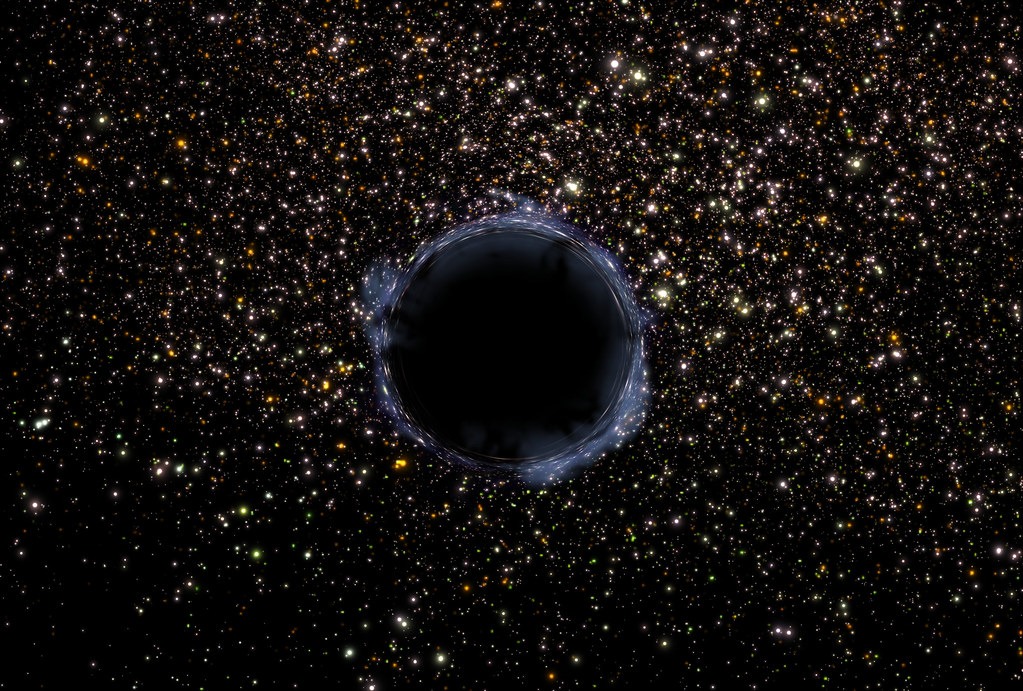
The 2025 Rankings: Top 10 Massive Black Holes
The following rankings represent the current scientific consensus as of 2025. These values are derived from a combination of direct observation, gravitational lensing models, and orbital motion studies.
10. M87* (Messier 87)
While it is the most famous black hole due to being the first ever photographed by the Event Horizon Telescope, M87* is now toward the bottom of the top 10 list.
- Mass: 6.5 billion solar masses
- Host Galaxy: Messier 87
- Light-Cross Time: Approximately 2.5 days to traverse the event horizon shadow.
9. NGC 1600
This giant was a surprise discovery because it resides in a relatively "lonely" galaxy rather than a dense cluster. It proves that massive growth can happen even without frequent galactic mergers.
- Mass: 17 billion solar masses
- Host Galaxy: NGC 1600
- Quick Fact: Its mass was determined by tracking the unusually high speeds of stars near the galactic center.
8. NGC 4889
Located in the Coma Cluster, this black hole was long considered one of the largest in the "local" universe. It is a classic example of a giant at the heart of a massive elliptical galaxy.
- Mass: 21 billion solar masses
- Host Galaxy: NGC 4889
- Light-Cross Time: Roughly 8 days.
7. APM 08279+5255
This is one of the most distant objects on the list. It is a quasar, meaning its central black hole is actively feeding and glowing with the intensity of trillions of suns.
- Mass: 23 billion solar masses
- Redshift: 3.911 (observed as it was when the universe was very young).
6. H1821+643
Situated in a cooling flow cluster, this black hole is a major player in the evolution of its surrounding environment, as its energy output prevents gas in the cluster from cooling and forming new stars.
- Mass: 30 billion solar masses
- Host Galaxy: Quasar H1821+643.
5. Abell 1201 BCG
This black hole is a landmark for the use of gravitational lensing. It is one of the largest "dormant" black holes ever measured, providing a benchmark for the discovery of other hidden giants.
- Mass: 32.7 billion solar masses
- Technique: Gravitational lensing and Einstein Ring analysis.
4. Cosmic Horseshoe Black Hole (LRG 3-757)
In August 2025, astronomers using gravitational lensing and stellar kinematics to identify an ultramassive black hole in the Cosmic Horseshoe galaxy with a mass of approximately 36 billion solar masses. This discovery highlighted how many more giants might be lurking in "fossil group" galaxies.
- Mass: 36 billion solar masses
- Host Galaxy: LRG 3-757.
The Top 3 Titans: Pushing Theoretical Limits
The top three entries on our list are so massive that they challenge our current models of how black holes grow. They exist at the very edge of what physics allows for a single gravitationally bound object.
3. Holmberg 15A
Holmberg 15A is an absolute behemoth located in the Abell 85 galaxy cluster. Its mass was confirmed through highly detailed stellar dynamical modeling, which showed that the stars at the center of the galaxy were being flung around at incredible speeds by a massive, central dark weight.
- Mass: 40 billion solar masses
- Quick Specs: The event horizon of this black hole would be large enough to swallow the orbit of Neptune many times over.
2. TON 618
For years, TON 618 was the undisputed king of the cosmos. As a hyper-luminous broad-absorption-line quasar, it is powered by an ultramassive black hole with a mass of approximately 66 billion times that of the Sun. The light we see from TON 618 left the quasar over 10 billion years ago. Its accretion disk is so bright that it outshines the combined light of all the stars in the Milky Way by thousands of times.
- Mass: 66 billion solar masses
- Significance: It represents the upper limit of the "quasar" stage of black hole growth.
1. Phoenix A*
As of 2025, Phoenix A* is estimated to be the most massive black hole candidate known, with a mass of approximately 100 billion solar masses, placing it at the theoretical upper limit of black hole growth. Located at the center of the Phoenix Cluster, this titan sits in a galaxy that is forming stars at a rate hundreds of times higher than our own Milky Way.
Phoenix A* is so large that the black hole mass comparison to sun for ultramassive giants begins to lose its meaning. To visualize it, if our Sun were the size of a single red blood cell, Phoenix A* would be the size of the Great Pyramid of Giza. At 100 billion solar masses, it is less of a single object and more like a dark sun around which thousands of galaxies revolve. Some theorists suggest that Phoenix A* might be a "Primordial" black hole that began growing just moments after the Big Bang, allowing it to reach this scale ahead of its peers.
FAQ
What is the most massive black hole ever discovered?
The current record holder is Phoenix A*, located in the Phoenix Cluster. It is estimated to have a mass of approximately 100 billion solar masses, which is roughly 23,000 times more massive than the supermassive black hole at the center of our own galaxy.
How do astronomers measure the mass of a black hole?
Astronomers use several methods, primarily observing how the black hole's gravity affects surrounding matter. For active black holes, they measure the speed of swirling gas in the accretion disk. For dormant ones, they use stellar kinematics to track star speeds or gravitational lensing to see how the black hole warps light from more distant objects.
What is the difference between a supermassive and an ultramassive black hole?
The distinction is based purely on scale. Supermassive black holes typically range from millions to several billion solar masses. Once a black hole exceeds 10 billion solar masses, it is classified as ultramassive. These larger objects usually form through the merger of multiple smaller supermassive black holes during galactic collisions.
Is there a theoretical limit to how large a black hole can get?
Yes, scientists believe there is a limit around 50 to 100 billion solar masses. Beyond this point, the accretion disk would become so large and unstable that it would fragment into stars before the gas could fall into the black hole, effectively cutting off its primary food supply.
How does Ton 618 compare to other large black holes?
TON 618 is one of the most well-documented giants with 66 billion solar masses. While Phoenix A* is estimated to be larger, TON 618 remains the gold standard for high-mass quasars. It is significantly larger than M87* (6.5 billion) and the newly discovered giant in the Cosmic Horseshoe (36 billion).
The search for the universe's largest objects is far from over. With the upcoming ESA Euclid mission and the continued work of the James Webb Space Telescope, we expect to find even more hidden giants lurking in the early universe, further refining our ultramassive black hole rankings and our understanding of gravity itself.