Quick Facts
- The Pioneer: ICQ (Launched 1996, shutdown 2024)
- Peak Market Share: AIM controlled 52 percent of the online messaging market by the mid-2000s
- Global Leader: MSN Messenger peaked at over 330 million monthly active users in 2009
- The AI Ancestor: SmarterChild (The early 2000s bot pioneer that lived on AIM and MSN)
- Modern Equivalent: Slack (The professional evolution of consumer real-time communication)
The most popular old chat apps of the late 1990s and early 2000s included AOL Instant Messenger (AIM), MSN Messenger, Yahoo Messenger, and ICQ. AIM dominated the North American market, pioneering features like Buddy Lists and away messages, while ICQ was the first to see mass global adoption. These platforms defined real-time digital communication, popularizing internet slang like A/S/L and stylized avatars during the dial-up era.
The Birth of Real-Time Communication
If you grew up during the transition from the Web 1.0 era to the modern internet, you probably remember the distinct sound of a 56k modem screeching to life. Before we had smartphones permanently glued to our palms, our social lives revolved around the desktop PC. The history of instant messenger apps is a journey from the slow, asynchronous world of email to an "always on" culture where your presence was signaled by a green icon and a clever status message.
In this guide, we are looking back at the old chat apps that paved the way for Slack, WhatsApp, and Discord. These weren't just tools; they were the primary way a generation learned to socialize online. From the frustration of dial-up internet being interrupted by a phone call to the excitement of seeing your crush sign on, these platforms were the heartbeat of the early web.
1. ICQ (1996 - 2024): The 9-Digit Identity
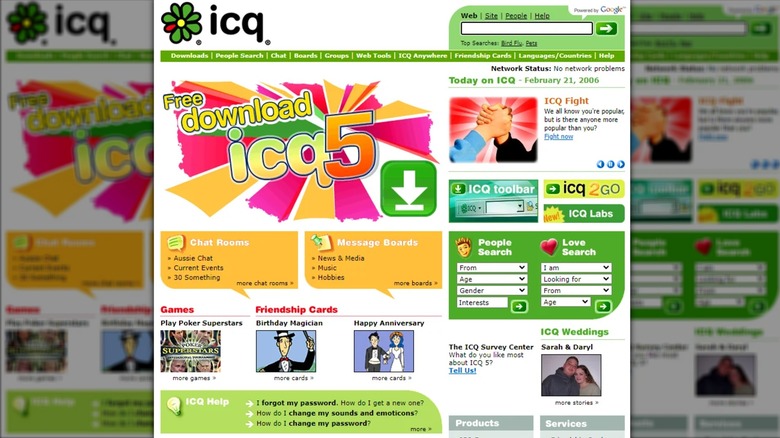
Long before AOL became a household name for chatting, a small Israeli company called Mirabilis changed everything with ICQ. The name, a play on the phrase "I Seek You," was the first global instant messenger to hit the mainstream. Unlike the screen names we use today, ICQ identified users through a unique User Identification Number (UIN).
During the late 90s, having a short UIN was a massive status symbol. If you were an early adopter with a five or six-digit number, you were considered internet royalty. Most of us, however, were stuck memorizing seven to nine digits. If you are trying to figure out how to find old icq uin numbers today, you might be out of luck; the service officially shut its doors in June 2024, ending a nearly 30-year run.
ICQ was technically advanced for its time, featuring:
- The iconic "Uh-oh!" notification sound when a message arrived.
- Multi-user chat rooms that laid the groundwork for modern community servers.
- File transfer protocols that were surprisingly robust for 1990s bandwidth.
- Its peak popularity arrived in 2001, when it boasted more than 100 million registered accounts.
Modern Equivalent: Telegram or Discord. ICQ's focus on global connectivity and technical features mirrors how power users utilize these modern platforms today.
2. AIM (1997 - 2017): The Culture of Buddy Lists
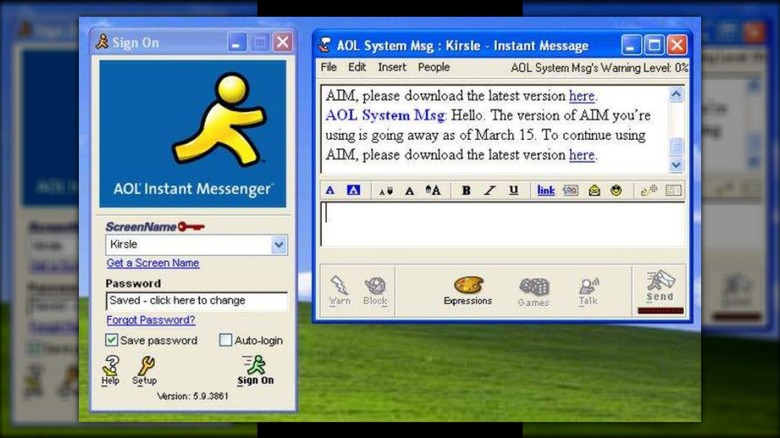
If you lived in North America in the early 2000s, AOL Instant Messenger (AIM) was likely your primary social hub. While ICQ was popular globally, AIM was the undisputed king of the US market. By 2001, it had approximately 36 million active users, and it eventually grew to control over half of the market share.
AIM gave us the Buddy List, a term so ingrained in the culture that we still use it colloquially. It also pioneered the Away Message, which was essentially the first version of a social media "status update." Whether you were "at soccer practice" or posting cryptic emo song lyrics to get someone's attention, the away message was our first taste of digital self-expression.
When performing an aim vs msn messenger feature comparison, AIM usually won on customization. The community around nostalgic 90s instant messenger buddy icons was massive, with users spending hours finding the perfect 32x32 pixel GIF to represent their personality. AIM was also the home of SmarterChild, a primitive chatbot that could give you movie times, weather reports, or just argue with you when you were bored.
3. MSN Messenger (1999 - 2014): The Social Connector
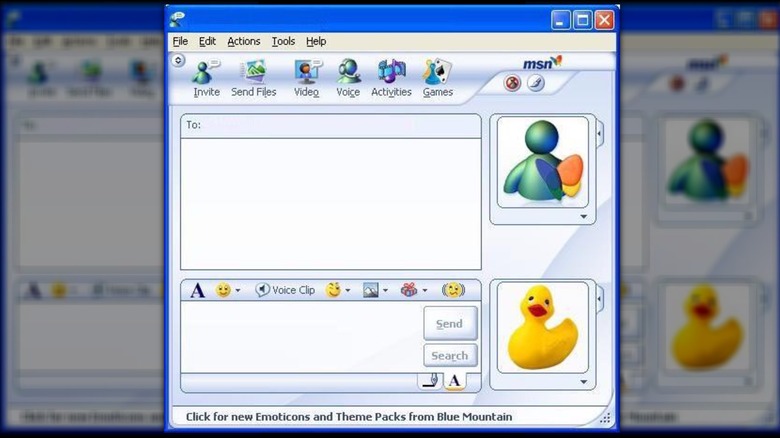
Microsoft entered the fray in 1999 with MSN Messenger. While it started as a basic clone of AIM, it eventually evolved into a powerhouse by integrating with Hotmail. If you had a PC running Windows, you likely had MSN Messenger pre-installed. By the mid-2000s, it had become one of the most popular 2000s chat programs globally, eventually rebranding to Windows Live Messenger.
MSN was known for being "loud." It introduced "Nudges" that would literally shake your friend’s chat window and "Winks"—full-screen animations that often featured singing characters or exploding hearts. It was also one of the early chat apps that allowed video calling, long before Skype or Zoom became industry standards.
Technical highlights of MSN included:
- Integration with the Windows Media Player "What I'm Listening To" status.
- The ability to play built-in games like Minesweeper Flags against your contacts.
- High-quality (for the time) webcam support and voice clips.
- A massive user base that reached a peak of over 330 million monthly active users.
Modern Equivalent: WhatsApp. MSN was the "default" chat app for the world's desktop users, much like WhatsApp has become the default for mobile users today.
4. Yahoo! Messenger & The Early Bots
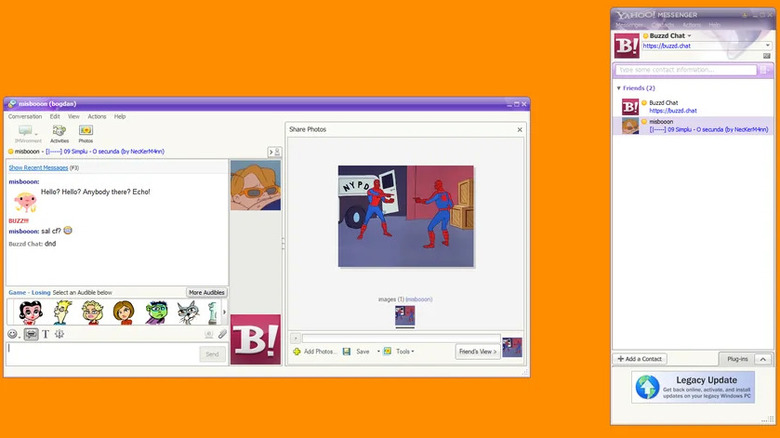
Yahoo! Messenger was the fourth pillar of the great IM wars. While AIM had the cool factor and MSN had the Microsoft ecosystem, Yahoo! Messenger focused on the "experience." They introduced IMVironments—interactive, themed backgrounds that would change the look of your entire chat window.
Yahoo was also famous for its "Buzz" button, which served the same purpose as the MSN Nudge, and its robust support for public chat rooms. These rooms were where the A/S/L (Age/Sex/Location) acronym truly became the standard greeting for the Web 1.0 generation. Yahoo also experimented heavily with the SmarterChild chatbot and other automated services, providing a glimpse into the future of AI-driven communication.
If you are identifying 90s messaging platforms by interface, Yahoo stood out for its use of purple and its distinctive set of "smileys" that were much more detailed than the basic yellow circles found on other platforms. It remained a staple for professionals in the oil and gas industry and finance for years after its mainstream popularity faded, purely because of its efficient file-sharing capabilities.
Why Classic Instant Messaging Services Closed Down
The decline of these old chat apps wasn't caused by a lack of users, but by a failure to adapt to the smartphone revolution. When the iPhone launched in 2007, the world shifted toward mobile-first social networks. Apps like WhatsApp and Facebook Messenger weren't tied to a desktop or a specific ISP; they were tied to your phone number and your existing social graph.
Many of these legacy software platforms struggled with monetization. While AOL and Yahoo were trying to sell banner ads within the chat window, newer platforms were building entire ecosystems. Eventually, the cost of maintaining servers for millions of users who weren't generating revenue became too high.
However, the spirit of these popular 2000s chat programs for pc lives on. Today, enthusiasts use community-run server emulators to log back into AIM or MSN Messenger using original software. These projects help preserve the history of instant messenger apps for researchers and nostalgic users alike, keeping the "Uh-oh!" sound alive for one more generation.
FAQ
What were the most popular early chat applications?
The "Big Four" that dominated the landscape from the late 90s through the mid-2000s were ICQ, AOL Instant Messenger (AIM), MSN Messenger (later Windows Live Messenger), and Yahoo Messenger. Each had its own regional stronghold, with AIM leading in the US and MSN Messenger leading globally.
Can you still access old chat messengers from the 90s?
Official servers for AIM, Yahoo Messenger, and MSN Messenger have all been shut down. However, community-driven projects like Escargot and Phoenix allow users to connect to custom servers using the original legacy software, effectively emulating the experience of the 90s and 2000s.
Which old chat apps are still active today?
Most of the classic standalone desktop messengers have been discontinued. ICQ was one of the longest-running services until its shutdown in 2024. IRC (Internet Relay Chat) is one of the few protocols from that era that is still widely used today, particularly by the developer and open-source communities.
What happened to classic instant messaging services?
They were largely displaced by the rise of mobile-first messaging apps and integrated social media platforms. As users moved from desktop PCs to smartphones, services like WhatsApp, iMessage, and Facebook Messenger offered better integration with mobile operating systems and contact lists.
Why did many older chat rooms close down?
The transition from public chat rooms to private, invite-only groups was driven by concerns over privacy and moderation. Many platforms found it difficult to police public rooms, and as social media evolved, users preferred the more curated and safer environments of platforms like Facebook, and later, Discord.