Quick Facts
- The Strip's Identity: It is a specialized RF-transparent window designed specifically to allow high-frequency signals to pass through the metal frame.
- Exclusive to Pro: This hardware feature is found only on the iphone 17 pro and Pro Max models due to their unique all-aluminum unibody construction.
- Regional Hardware: The visible strip is primarily a feature of North American models, which support specific high-speed network bands.
- Material Shift: Apple has moved to a high-grade aluminum chassis for the Pro series, which offers 20x better heat conduction than the previous titanium series.
- Thermal Innovation: The hardware now includes a sophisticated vapor chamber cooling system using deionized water to manage the A19 Pro chip heat.
- The Direct Answer: The plastic strip on the top edge of the iphone 17 pro is an RF-transparent window designed for 5G mmWave antennas to bypass the signal-blocking aluminum frame. This dedicated cutout ensures that users in the United States and other mmWave-enabled regions can access gigabit-speed connectivity without interference from the device's premium metal exterior.
Every time Apple updates its industrial design, there is always one small detail that sparks a thousand forum threads. For the 2026 flagship cycle, that detail is the mysterious dark strip located on the top edge of the frame. While some initially speculated it might be a new sensor or a docking port for accessories, the reality is grounded in the fundamental laws of physics and wireless signal transmission.
Solving the Mystery: The Material Science of the Top Strip
To understand why the iphone 17 pro features this visual break in its frame, we have to look at the chassis engineering. For the first time in several generations, Apple has moved away from the titanium-glass sandwich towards a more integrated aluminum unibody construction. Aluminum is a phenomenal material for structural integrity and heat management, but it has one major drawback: it is radio-opaque.
Unlike the glass backs used on previous models and the standard iphone 17, a solid aluminum back and frame act as a Faraday cage. This cage blocks the high-frequency spectrum required for modern 5G networks. Engineers faced a significant challenge: how to maintain a sleek, metallic aesthetic while ensuring the device can actually communicate with cell towers.
The solution is the RF-transparent window located at the top of the device. This strip is made of a high-durability polymer designed to match the color of the iphone 17 pro as closely as possible while being completely invisible to radio waves. By placing the iphone 17 pro mmwave antenna directly behind this window at the top edge, Apple ensures that signal attenuation is minimized.
This specific relocation is a response to how we hold our phones. In previous years, antenna windows were often placed on the sides. However, through heavy handheld use—especially in landscape mode for gaming or streaming—users' hands would often cover those side windows, leading to a phenomenon colloquially known as death grip. Moving the window to the top profile creates a clear path for the signal to reach the cell tower, even when your hands are wrapped around the device.
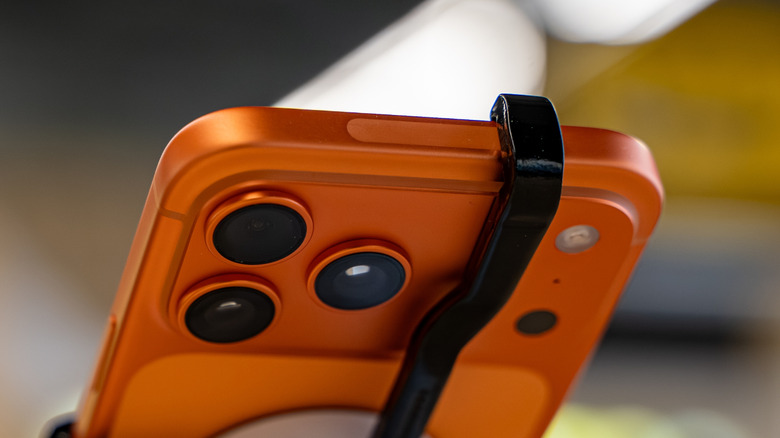
iPhone 17 Pro vs 17: Why Only the Pro Has the Strip
One of the most common questions regarding the new lineup is why the base model looks cleaner than the Pro from the top. If you compare the iphone 17 pro vs 17 hardware, the difference comes down to the choice of materials. The standard iphone 17 continues to use a glass back panel. Since glass is naturally transparent to radio frequencies, the 5G antennas can be tucked away behind the rear plate without needing an external window.
The iphone 17 pro represents a higher level of hardware evolution where structural strength and cooling are prioritized. The aluminum unibody of the Pro model is far more rigid but requires these tactical cutouts to function. Furthermore, there are significant iphone 17 pro us vs international model differences to consider.
In many international markets where mmWave 5G is not yet deployed, the iphone 17 pro may ship with a completely solid frame, lacking the top strip entirely. This is because the lower-frequency Sub-6GHz 5G signals can often be managed through smaller, more discreet antenna lines rather than a dedicated high-frequency window. For North American users, however, the strip is the hallmark of a device capable of gigabit-speed connectivity.
Antenna Placement Evolution
| iPhone Model | Antenna Window Location | Chassis Material |
|---|---|---|
| iPhone 12 Pro | Right Side (Small Window) | Stainless Steel |
| iPhone 14 Pro | Right Side (Large Window) | Stainless Steel |
| iPhone 16 Pro | Integrated / Side Frame | Titanium |
| iPhone 17 Pro | Top Edge (Dedicated Strip) | Aluminum Unibody |
Beyond just the antenna, the Pro model offers significant functional advantages that justify the complex chassis engineering. This includes a higher 120Hz variable refresh rate and a battery rated for up to 33 hours of video playback, a feat made possible by the efficiency of the new internal layout.
Thermal Performance: The Real Reason for Aluminum
If aluminum creates such a headache for wireless signal transmission, why switch to it at all? The answer lies in the silicon. The new A19 Pro chip is a powerhouse, but with great power comes the need for extreme cooling. The A19 Pro chip built on an upgraded 3-nanometer process features a 16-core Neural Engine and 12GB of RAM. Processing complex AI tasks locally on the device generates significant heat.
Aluminum has thermal conductivity properties that are roughly 20 times better than titanium. By using an aluminum unibody construction, the entire frame of the iphone 17 pro acts as a massive heat sink. To further enhance this, the iPhone 17 Pro Max utilizes a vapor chamber cooling system containing deionized water.
This system works by evaporating the deionized water near the chip and condensing it at the cooler edges of the aluminum frame. This constant cycle dissipates thermal energy far more efficiently than the graphite sheets used in previous models. The strip at the top is the small price users pay for a phone that can maintain peak performance during long gaming sessions or 4K video editing without throttling its processor.
Design & Colors: The 2026 Pro Aesthetic
Apple has gone to great lengths to ensure that the iphone 17 pro colors and finishes guide accommodates this necessary hardware strip. The aluminum is treated with a new bead-blasted finish that gives it a matte, premium feel, and the RF-transparent window is precision-dyed to match the metallic sheen of the body.
The current iphone 17 pro colors include:
- Graphite Aluminum: A deep gray where the top strip is almost invisible.
- Silver Satin: A classic look where the strip appears as a slightly darker accent.
- Midnight Cobalt: A rich blue that masks the antenna window effectively.
- Desert Copper: A warm, earthy tone that highlights the industrial design aesthetics.
Each color is protected by a new iteration of Ceramic Shield, which Apple calls Ceramic Shield 2, promising even better drop resistance. When you combine this with the aluminum unibody, the iphone 17 pro becomes one of the most durable devices ever made, even if it does have that one specific "plastic" window on top.
For the enthusiast, the answer to what is the plastic strip on top of iphone 17 pro is not just "it's an antenna." It is a symbol of the complex balancing act between material science, cooling requirements, and the pushing of 5G boundaries. It represents the hardware evolution necessary to support the most powerful mobile chip ever designed.
FAQ
Is the iphone 17 pro actually good?
The iphone 17 pro represents a major shift in design philosophy, moving toward aluminum for better thermals and structural integrity. For users who value sustained performance in gaming or AI tasks, the cooling improvements and the A19 Pro chip make it an exceptional upgrade. The addition of 12GB of RAM specifically improves the longevity of the device for multi-tasking.
Will the iphone 17 pro price?
Historically, Apple maintains a consistent pricing ladder for the Pro models, usually starting around $999 in the US. However, given the significant shift to an aluminum unibody and a more complex vapor chamber cooling system, there is always the possibility of a slight price adjustment to account for increased manufacturing complexity in the North American models.
Why not buy iphone 17 pro?
If you rarely use 5G mmWave networks and prefer a cleaner, uninterrupted frame design, the base iphone 17 might be more appealing. Additionally, if the visual presence of an antenna strip on the top of the frame bothers your sense of symmetry, you might find the standard models or the international versions more aesthetically pleasing.
What are the disadvantages of the iphone 17 pro?
The primary disadvantage for some will be the visual trade-off of the RF-transparent window on the top edge. Furthermore, the move to aluminum—while better for cooling—may lack the extreme scratch resistance that titanium or stainless steel frames offered in previous years. The phone is also heavily optimized for the US market, meaning some hardware features like the mmWave antenna are dormant or missing in other regions.
Is it worth upgrading from iPhone 16 to iphone 17 pro?
The upgrade is worth it if you are pushing your phone to its limits. The jump from 8GB to 12GB of RAM is significant for on-device AI efficiency. Furthermore, the new vapor chamber cooling means the phone will feel cooler in your hand and perform better under load compared to the iPhone 16. If you are satisfied with your current speed and thermal performance, the difference in daily tasks like browsing or social media will be minimal.