Quick Facts
- Ad Removal: Meta purged over 159 million scam ads in 2025 to clean up user feeds.
- Proactive Defense: About 92% of fraudulent activity is now caught by AI before any user reports it.
- Account Crackdown: More than 6.8 million WhatsApp accounts tied to organized crime were deleted in early 2025.
- Verified Revenue: Meta aims for 90% of ad revenue to come from verified advertisers by late 2026.
- New Privacy Feature: WhatsApp AI Incognito Mode launched on May 13, 2026, for safer AI interactions.
- Real-time Alerts: Users now receive geographic location data when a new device tries to link to their WhatsApp.
- Security Choice: Messenger users can now choose to bypass encryption specifically for AI safety reviews of suspicious chats.
As digital fraud reaches record levels, Meta has deployed advanced AI scam protection across its global platforms. These new Meta security alerts are designed to proactively block social engineering tactics before users fall victim. By integrating behavioral analysis and real-time threat detection, Meta is fundamentally changing how WhatsApp and Messenger handle security.
The State of Fraud: Why AI Scam Protection is Essential in 2026
The landscape of mobile security has shifted dramatically over the last few years. It is no longer just about avoiding a suspicious link in an email; it is about protecting our primary communication hubs. In 2024 alone, data indicated that billions were lost to cyber-fraud globally. In the United States, reports suggest that 76% of US fraud cases originated on social platforms in 2023, creating an urgent need for more robust, automated defenses.
For those of us who live on our smartphones, the threat of social engineering is constant. Scammers have become experts at impersonating loved ones or offering "too good to be true" job opportunities. Meta is responding to this by moving away from reactive bans toward proactive economic disruption. By using behavioral analysis, the system can identify patterns—such as a sudden surge in messages from a new account or mismatched location data—and intervene immediately.
One of the most interesting concepts Meta is introducing is what I call positive friction. Usually, as a tech editor, I advocate for seamless user experiences. However, when it comes to security, slowing the user down can be a lifesaver. When the system detects a location mismatch in a friend request, it triggers Facebook alerts for suspicious friend requests explained through clear, actionable UI prompts. This forces a moment of reflection: Do you really know this person from London if you live in New York?
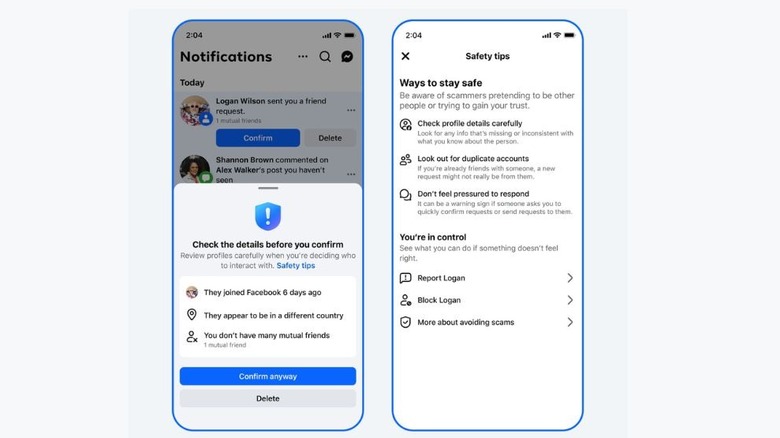
In 2025, Meta removed over 159 million scam ads, and the vast majority—92%—were blocked before they ever reached a user’s screen. This is a massive shift in scale that only AI can manage.
WhatsApp: Advanced Device Linking Protection and AI Incognito
WhatsApp has always been the gold standard for personal privacy due to its end-to-end encryption. However, scammers have found ways to exploit user trust through account takeover attempts. To combat this, WhatsApp device linking protection has received a major upgrade.
Now, whenever a new device attempts to link to your account via a QR code, you will receive a detailed security prompt. This alert doesn't just say a device is trying to connect; it shows the geographic location of the requesting device. If you are sitting in Los Angeles and you see a linking request from someone in Eastern Europe, you know immediately that something is wrong. The UI allows you to tap a "Don't link" option, which instantly terminates the unauthorized session.
Another breakthrough is the WhatsApp AI Incognito Mode, which officially launched on May 13, 2026. This feature uses a session-based deletion architecture. When you interact with Meta’s integrated AI tools, your data is processed but not stored as part of your permanent profile. This minimizes the risk of data leaks that could lead to identity theft. For power users, checking your WhatsApp AI incognito mode privacy settings should be your first task after the next update.
Red Flag Alert: If you receive a notification for a device link that you did not initiate, do not ignore it. Scammers use these links to gain access to your recent chat history and impersonate you to your contacts.
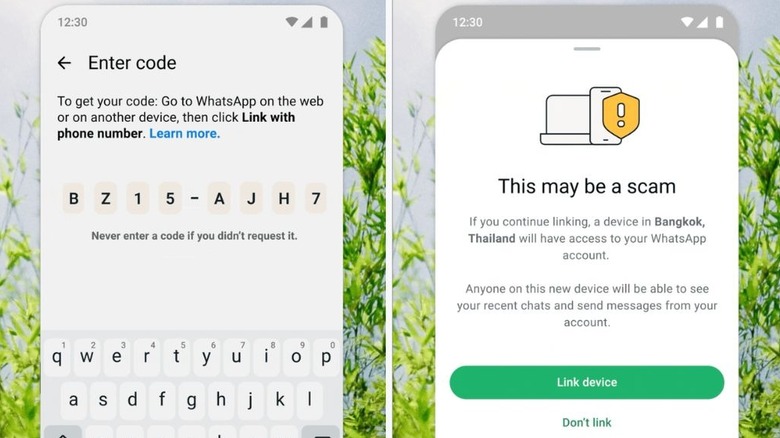
Meta’s commitment to account safety is reflected in the numbers. In the first half of 2025, the company took action to remove 6.8 million WhatsApp accounts that were tied to organized crime syndicates and AI-driven scam operations.
Messenger: Targeting Fake Job Offers and Brand Spoofers
Messenger users face a different set of challenges, particularly phishing tactics involving celebrity impersonation and fake job offers. Meta’s AI scam protection on Messenger now utilizes social graph density analysis. Essentially, the AI looks at how many mutual friends you have with a person reaching out. If an account claiming to be a high-profile figure or a recruiter has zero connection to your existing social circle, the app flags it.
Messenger scam detection for fake job offers has become particularly sophisticated. The AI monitors for specific behavioral analysis patterns, such as an immediate pivot to discussing "quick money" or asking for financial information early in a conversation. These interactions are met with visual alerts that warn users about the account's low mutual friend count and suspicious behavior.
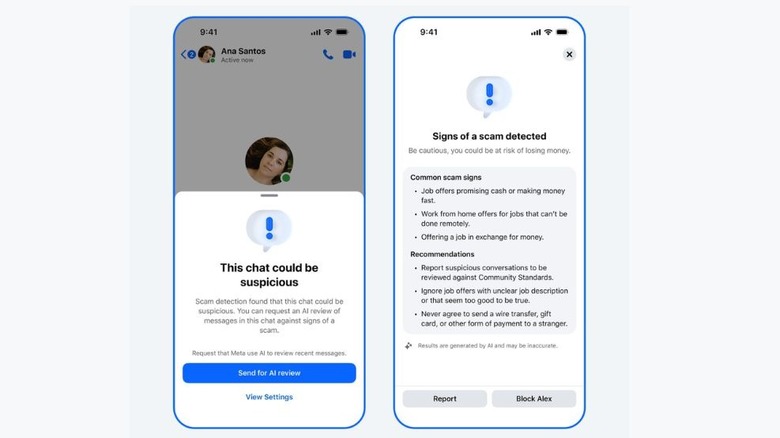
This proactive approach is part of a broader business strategy. Meta has established a goal for verified advertisers to generate 90% of its ad revenue by the end of 2026, up from approximately 70% in early 2026. By ensuring that the people and brands you interact with are who they say they are, Meta is trying to make the platform inherently less profitable for scammers.
The Catch: End-to-End Encryption vs. AI Safety Reviews
There is an ongoing debate in the tech world regarding the balance between privacy and safety. How can Meta scan for scams if your chats are encrypted? This is where the Messenger advanced scam detection system gets clever.
While your messages remain end-to-end encrypted by default, Meta has introduced an "AI Safety Review" option. If you receive a message that feels "off"—perhaps a strange request for money from a friend—you can choose to submit that specific chat for AI review. By doing this, you are choosing between AI chat review and encryption on Messenger for that specific instance. Selecting this option temporarily bypasses encryption for those specific messages, allowing Meta’s systems to analyze the content for phishing tactics or financial fraud prevention.
| Feature | WhatsApp Security | Messenger Security |
|---|---|---|
| Primary Protection | Device Linking Alerts | Mutual Friend Verification |
| New AI Feature | AI Incognito Mode | Advanced Scam Detection |
| Scam Focus | Account Takeover | Fake Job Offers / Impersonation |
| User Control | Real-time Location Blocking | Optional AI Safety Review |
| Encryption Status | Full E2EE by Default | Full E2EE with Optional Reporting |
This creates a digital safety protocol where the user is in control. You aren't giving up your privacy across the board; you are simply asking for a digital bodyguard to take a look at a specific door that looks suspicious.
Beyond the App: The FIRE Framework and Global Enforcement
Meta isn't working in a vacuum. The fight against modern fraud requires law enforcement cooperation and industry-wide collaboration. One of the most significant developments is the Fraud Intelligence Reciprocal Exchange (FIRE). This framework allows Meta to share data with financial institutions like NatWest to track the flow of money in scam operations.
We are seeing the results of this cooperation in the real world. During the Bangkok Joint Disruption Week, coordinated efforts led to 21 arrests and the shutdown of over 150,000 accounts. This shows that AI scam protection isn't just a software update; it is part of a global movement to make the internet a harder place for criminals to operate.
The goal isn't just to block a message; it’s to destroy the infrastructure that scammers rely on. By combining real-time threat detection with aggressive legal action, Meta is trying to flip the script on social engineering.
FAQ
How can I protect myself from AI scams?
The best way to protect yourself is to pay attention to the Meta security alerts that appear in your apps. Always use two-factor authentication, and never share a verification code with anyone. If you receive a request for money or personal info, even from someone you think you know, verify their identity through a different channel like a phone call.
What is AI scam protection and how does it work?
It is a system that uses behavioral analysis to identify fraudulent patterns in real-time. It looks for signals like accounts that were created recently, accounts with no mutual friends, or devices trying to link from unusual geographic locations. It then provides users with prompts to block these interactions before any damage is done.
Can AI tools help prevent identity theft?
Yes, tools like WhatsApp AI incognito mode privacy settings help by ensuring your interactions with AI aren't stored in ways that could be exploited. Furthermore, the proactive detection of account takeover attempts prevents scammers from stealing your digital identity to defraud your contacts.
What steps should I take if I have been targeted by an AI scam?
If you suspect you have been targeted, immediately use the "Report" feature within the app. If it’s on Messenger, you can choose to submit the chat for an AI safety review. If your account has been compromised, use the official account recovery tools on the Meta website and change your passwords immediately across all linked services.
As someone who tracks mobile trends daily, I see these updates as a necessary evolution. The convenience of our connected lives shouldn't come at the cost of our financial security. While Meta is doing a lot of the heavy lifting with AI scam protection, your own vigilance remains the most important line of defense. Keep your apps updated, trust those security prompts, and stay skeptical of anything that seems too good to be true.