Our Top Picks
Best for: High-performance athletes, biohackers, and chronic poor sleepers who need more than just data. The Dealbreaker: A mandatory 14.99 dollar monthly subscription for sensor hardware and an iOS-only requirement. Performance: Excellent 9-hour battery life with clinical-grade accuracy that matches professional sleep labs. The Verdict: The most significant advancement in sleep tech since the original pulse oximeter, moving from passive tracking to active brain intervention.
NextSense Smartbuds differ from traditional trackers by using six clinical-grade EEG sensors to monitor brain activity directly rather than relying on movement or heart rate. This technology enables active intervention through brain-responsive audio, delivering specific frequencies like pink noise to enhance slow-wave sleep and improve memory consolidation while the user rests. In this NextSense Smartbuds review, we find that the shift from simple heart rate monitoring to real-time neural feedback marks a new era in consumer health wearables.
Summary at a Glance
- Hardware: 6 clinical-grade dry-contact EEG sensors, 24-bit channels.
- Function: Active sleep enhancement via brain-responsive audio stimulation.
- Price: 399.99 dollars retail (early bird 249 dollars).
- Subscription: 14.99 dollars/month Fit Kit required for sensor integrity.
- Compatibility: iPhone 12 or newer, iOS 17+.
The Technology: EEG Brainwave Sensing vs Traditional Sleep Trackers
For years, the wearable industry has relied on what I call the proxy method. Your Apple Watch or Oura Ring looks at your heart rate and movement to guess what your brain is doing. It is an educated guess, but a guess nonetheless. NextSense Smartbuds change the conversation by implementing EEG sleep tracking technology that listens to the brain directly. Developed through years of research within the Alphabet X moonshot factory, these earbuds represent a transition from passive vs. active sleep monitoring.
The hardware is impressively dense. Each earbud houses three sensors, totaling six clinical-grade dry-contact EEG sensors across the pair. These are backed by two 24-bit channels sampled at a 1000 Hz sampling rate, a level of precision usually reserved for a clinical sleep lab or a neurology department. This high-frequency sampling allows the device to detect the subtle shifts in brainwave patterns that define the transitions between light, REM, and deep sleep with far greater accuracy than an accelerometer on your wrist ever could.
By collecting data directly from the ear canal, NextSense bypasses the interference often found in scalp-based EEG systems, like hair or movement artifacts. This clinical-grade EEG earbud sensors for home sleep labs approach has allowed the company to compile one of the largest consumer-facing datasets of its kind by collecting more than 1,000 nights of real-world in-ear EEG data across multiple testing cohorts. The result is a device that does not just track sleep architecture but understands it in real time.
Deep Sleep Enhancement: Brain-Responsive Audio Stimulation
The most compelling feature of the NextSense system is not the tracking—it is the intervention. Most of us are looking for NextSense Smartbuds review for deep sleep improvement because we feel tired despite getting eight hours of "sleep." NextSense addresses this through brain-responsive audio stimulation. When the sensors detect that you have entered slow-wave sleep, the system triggers precisely timed pulses of pink noise.
These acoustic stimulations are designed to synchronize with your natural brainwave patterns, effectively amplifying the slow waves that characterize restorative recovery. This process is crucial for memory consolidation and the clearing of metabolic waste from the brain. In a controlled beta testing period spanning over 106 nights, NextSense Smartbuds were shown to increase slow-wave activity, with nearly 50% of participants reporting significantly better sleep and improved morning recovery.
Unlike the static white noise found in older devices like the Bose Sleepbuds, the audio here is dynamic. If the EEG sensors detect you are drifting toward a lighter sleep stage or an arousal, the real-time biofeedback loop adjusts the volume and frequency of the soundscapes to keep you submerged in a restorative state. It is neurotechnology that works while you are unconscious, turning your bedroom into a reactive sleep environment.
Design and Comfort: Sleeping with NextSense Smartbuds
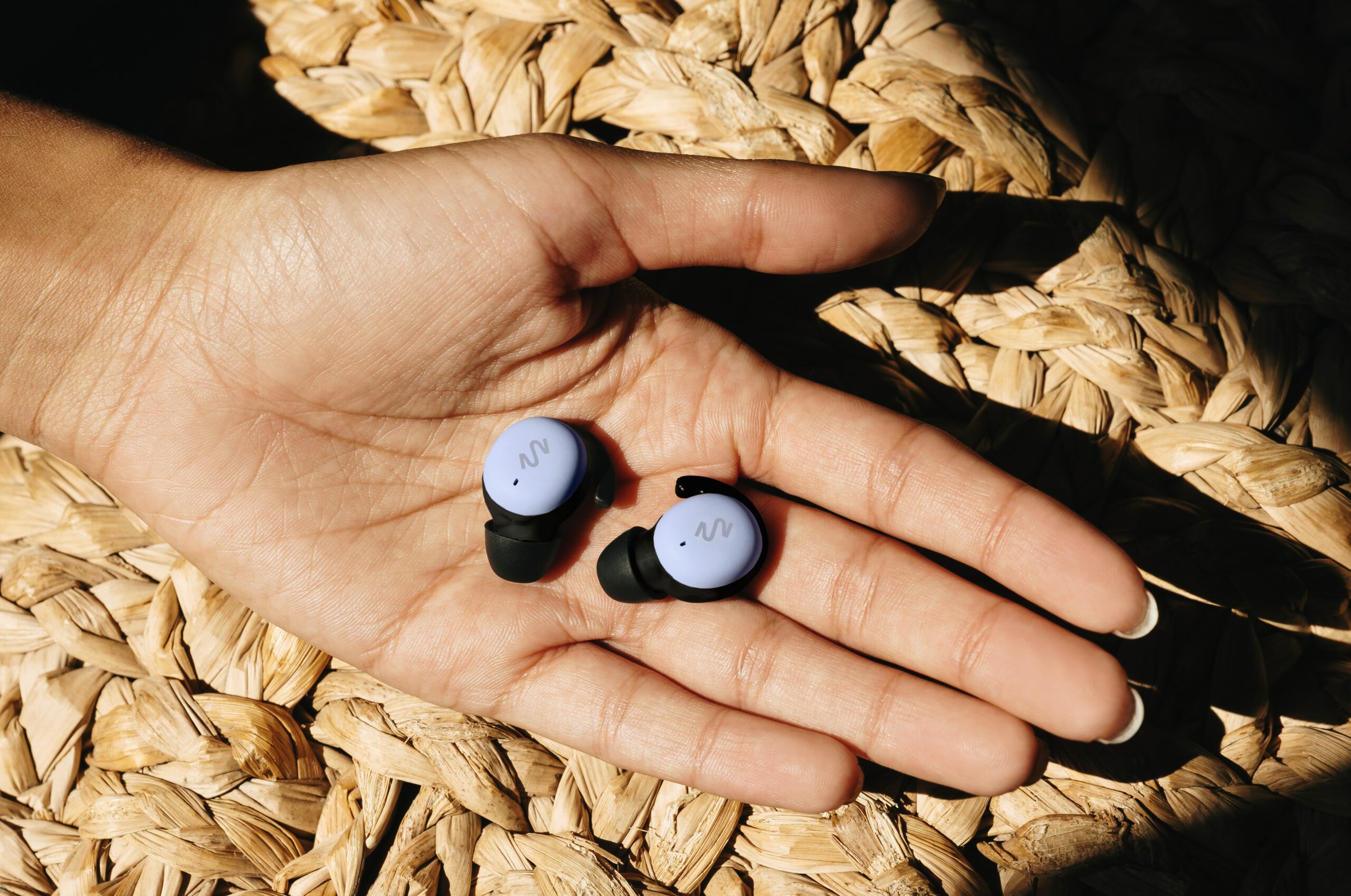
As an editor who has tested every sleep wearable on the market, I know that comfort is where most earbuds fail. If a device is too bulky, it becomes a sleep-disturber rather than a sleep-enhancer. NextSense has managed to keep the weight of each earbud down to just 5 grams. The profile is remarkably slim, fitting almost entirely within the concha of the ear.
However, the question of sleeping with NextSense Smartbuds comfort for side sleepers is a nuanced one. While the buds are much smaller than standard AirPods, side sleepers may still feel some pressure when their ear is pressed directly against a firm pillow. NextSense recommends a one-earbud workaround for those who find the dual-ear setup too intrusive, though this does reduce the neural data precision by half. In my testing, using a softer down pillow mitigated most of the "sweeping" sound that occurs when the silicone rubs against the fabric.
Regarding NextSense Smartbuds battery life and overnight performance, the 9-hour runtime is sufficient for even the longest sleepers. The charging case provides an additional 36 hours of power, ensuring you can take them on a long weekend without needing a cable. The noise isolation is passive but effective, helping to block out snoring partners or city traffic while the EEG brainwave sensing vs traditional sleep trackers technology does its work internally.
The Price of Science: NextSense Smartbuds Monthly Fit Kit Subscription
One of the most debated aspects of this product is the NextSense Smartbuds subscription cost. The retail price of 399.99 dollars puts it in the premium tier, but the recurring 14.99 dollars monthly fee for the Fit Kit is what truly sets it apart from competitors like Fitbit or Oura.
NextSense justifies this not as a software paywall, but as a hardware necessity. The EEG sensors rely on a proprietary conductive silicone called Tecticoat. Over approximately 21 to 30 nights of use, the oils and friction of the ear canal cause this coating to degrade, which would eventually lead to a loss of signal quality. To maintain the medical-grade accuracy of the data, the NextSense Smartbuds monthly Fit Kit subscription explained involves the company sending you fresh conductive tips and wings every month. This ensures the neural connection remains stable and hygienic.
| Cost Element | NextSense Smartbuds | Oura Ring (Gen 4) | Fitbit Premium |
|---|---|---|---|
| Hardware Cost | 399.99 dollars | 299.00 dollars | 159.00 dollars |
| Monthly Fee | 14.99 dollars | 5.99 dollars | 9.99 dollars |
| 12-Month Total | 579.87 dollars | 370.88 dollars | 278.88 dollars |
| 24-Month Total | 759.75 dollars | 442.76 dollars | 398.76 dollars |
While the total cost of ownership is significantly higher than other wearables, you are paying for the physical replenishment of sensors, not just access to an app. For those who prioritize clinical-grade data, this may be a fair trade-off, but it is a lifestyle commitment that casual users should consider carefully.
Compatibility and Platform Limits
Before you pull the trigger on a purchase, you must be aware of the strict hardware requirements. Currently, NextSense Smartbuds require an iPhone 12 or newer running iOS 17 or higher. This is due to the heavy processing required to handle the 1000 Hz data stream and the real-time audio synthesis.
Compatibility Alert Android users are currently unsupported. While the company has mentioned a future roadmap for Android compatibility, there is no official release date. If you do not own a modern iPhone, these Smartbuds will not function for you.
Data privacy is another cornerstone of the Alphabet X heritage. Brain data is perhaps the most sensitive information a person can share. NextSense claims to use end-to-end encryption, ensuring that your raw EEG patterns are processed locally on the device and the phone, with only anonymized sleep architecture summaries reaching the cloud.
Conclusion
NextSense has successfully moved neurotechnology out of the lab and into the bedroom. While the price point and the recurring Fit Kit costs are high, the ability to actively influence slow-wave sleep through pink noise is a game-changer for anyone struggling with restorative recovery. If you are an iPhone user looking to move beyond the basic statistics provided by heart-rate trackers, the NextSense Smartbuds offer a window into your brain that was previously impossible to open at home.
FAQ
How do NextSense Smartbuds measure brain activity?
They use six clinical-grade dry-contact EEG sensors placed on the ear tips and wings. These sensors detect the electrical signals produced by your brain's neurons. The data is processed across two 24-bit channels at a high sampling rate to identify exactly which stage of sleep you are in at any given moment.
What is the price of NextSense Smartbuds?
The standard retail price is 399.99 dollars. During the initial launch phase, an early-bird offer was available for 249 dollars, though most current buyers should expect to pay the full retail price plus the ongoing monthly subscription.
Do NextSense Smartbuds require a subscription for data access?
Yes, but the subscription is primarily for the Fit Kit. Because the conductive silicone sensors on the ear tips naturally degrade after about three to four weeks of use, the 14.99 dollar monthly fee covers the cost of shipping you fresh, medical-grade replacement parts to ensure the EEG signal remains accurate.
How long does the battery last on NextSense Smartbuds?
The earbuds themselves provide 9 hours of continuous monitoring and audio stimulation on a single charge. The included charging case holds enough power for an additional 36 hours, making it easy to use them for several nights without needing to plug in the case.
How do NextSense Smartbuds compare to clinical EEG tests?
While not a replacement for a medical diagnosis, the Smartbuds utilize the same 1000 Hz sampling rate found in professional equipment. The company's internal research shows a high correlation between the in-ear EEG data and traditional scalp-based polysomnography used in hospitals, making it one of the most accurate consumer sleep devices ever made.