Our Top Picks
The Samsung Galaxy Z TriFold is the ultimate mobile workstation for power users who refuse to carry both a tablet and a phone. With its massive 10-inch display and high-performance Snapdragon 8 Elite chip, it sets a new benchmark for productivity, though its $2,899 price tag and 309-gram weight make it a niche tool for early adopters rather than a mainstream choice.
The Samsung Galaxy Z TriFold has officially arrived, redefining the foldable market with a massive 10-inch display that collapses into a 6.5-inch phone. At $2,500, it’s a premium workstation featuring dual titanium hinges and the Snapdragon 8 Elite. Following its initial debut in South Korea in late 2025, the Samsung Galaxy Z TriFold was officially released in the United States on January 30, 2026, with a starting retail price of 2,899 dollars.
Engineering the Future: Dual Titanium Hinges and Durability
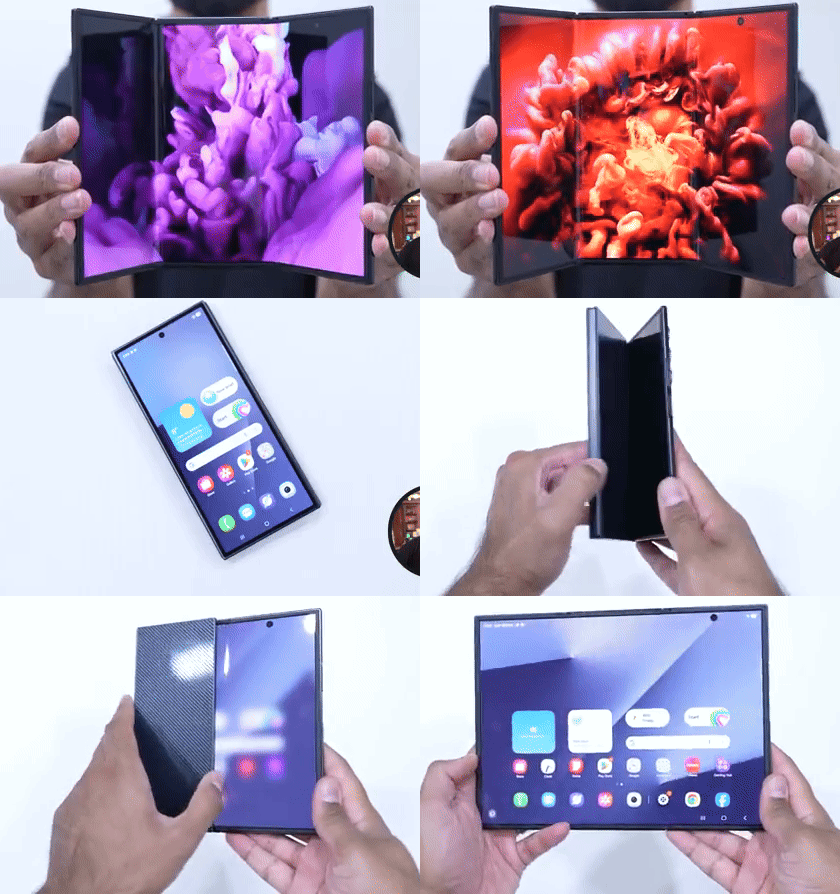
The first question every reader asks me about a trifold device is: will it break? After spending two weeks putting this device through its paces, I can say that Samsung has engineered something remarkably sturdy. The Samsung Galaxy Z TriFold utilizes an inward-folding design supported by a dual titanium hinge system. These hinges feel significantly more robust than the single hinge found on the standard Z Fold series, offering a satisfying, damped resistance when unfolding.
To protect the internal components, Samsung uses an Advanced Armor aluminum frame and Corning Gorilla Glass Ceramic 2 on the outer panels. The engineering team clearly anticipated the risks of a complex folding mechanism. We found that the device includes specialized protective software that monitors the hinge position. If the sensors detect an improper fold or excessive pressure, the device issues a combination of vibration and visual warnings to prevent mechanical failure.
Environmental protection is also surprisingly high for such a complex machine. The Samsung Galaxy Z TriFold features IP48 water resistance, meaning it can survive a splash or a rainy commute, though you still shouldn't take it for a swim. This level of durability is essential as the global foldable smartphone market is projected to grow to 30.04 billion dollars in 2025, reflecting an increasing consumer expectation that these high-end devices can survive real-world mishaps.

The 10-Inch Powerhouse: Productivity and Multitasking
When you fully expand the Samsung Galaxy Z TriFold, you are greeted by a 10-inch Dynamic AMOLED 2X main display. This isn't just a slightly larger phone screen; it is a genuine tablet experience. The 16:11 aspect ratio provides a canvas that feels much more natural for work than the narrower screens of previous foldables.
The true magic happens within One UI 8.0, which has been optimized specifically for this form factor. The 10-inch foldable display productivity is most evident when using triple-app multitasking. I found myself running a Zoom call on one-third of the screen, a web browser on the second, and a notes app on the third. Unlike smaller foldables where three apps feel cramped, the TriFold gives each window enough breathing room to be genuinely useful.
For those who want to push the device further, Samsung DeX integration allows the TriFold to act as a secondary monitor or a standalone desktop when connected to a keyboard. During my testing, I used the Samsung Galaxy Z TriFold 10-inch screen productivity multitasking features to draft an entire editorial while on a cross-country flight, and for the first time, I didn't feel the urgent need to pull out my laptop.
The Trifold Trade-offs: Weight, PPI, and S Pen
No device is perfect, and the Samsung Galaxy Z TriFold asks you to accept some significant compromises in exchange for that massive screen. The most obvious issue is the bulk. At 309 grams, it is 94 grams heavier than the Z Fold 7. In my daily use, I constantly asked: is the Samsung Galaxy Z TriFold too heavy for daily use? If you are wearing gym shorts or loose pockets, the answer is a resounding yes. It feels like carrying a small tablet in your pocket, and the 12.9mm thickness when folded is a noticeable increase over the sleeker Z Fold 7.
Another trade-off involves the display density. To manage power consumption and manufacturing yields on such a large panel, the Samsung Galaxy Z TriFold features a pixel density of 269 PPI. When compared to the 368 PPI found on the Z Fold 7, the difference is visible if you look closely. Text is slightly less sharp, and high-resolution photos don't pop quite as much as they do on Samsung’s smaller flagships.
Finally, there is the disappointing lack of S Pen support. Due to the complex nature of the dual titanium hinge and the specific thickness requirements of the digitizer, Samsung has not included an internal S Pen or even a compatible layer for an external one on this first-generation trifold. For many power users, this might be a dealbreaker.
Performance and Battery: A Laptop Replacement?
Under the hood, the Samsung Galaxy Z TriFold is a beast. Powered by the Snapdragon 8 Elite processor and 16GB RAM, it handled every task I threw at it without a hint of lag. Whether it was rendering 4K video or switching between half a dozen open apps, the performance remained top-tier.
To keep that massive AMOLED panel running, Samsung engineered a unique three-cell battery architecture with a total 5,600 milliamp-hour battery capacity. In my testing, the Samsung Galaxy Z TriFold battery life for laptop replacement scenarios was respectable, lasting about 7 to 8 hours of continuous heavy multitasking. While this won't beat a dedicated MacBook, it is enough to get through a workday with moderate use.
Charging is handled by a 45W fast charging system. While 45W is standard for Samsung, it feels a bit slow when trying to fill up a large 5,600 mAh battery. A full charge takes over 80 minutes, which is something to keep in mind if you are a frequent traveler.
Z TriFold vs. Z Fold 7: Is the $1,000 Gap Worth It?
Choosing between the established Z Fold line and the new trifold is the biggest decision for Samsung fans this year. The Z Fold 7 is more refined, lighter, and significantly more affordable at roughly $2,000. However, the TriFold offers a level of utility that the smaller foldable simply cannot match.
| Feature | Samsung Galaxy Z TriFold | Samsung Galaxy Z Fold 7 |
|---|---|---|
| Main Display | 10-inch AMOLED | 8-inch AMOLED |
| Price | $2,899 | $1,999 |
| Weight | 309g | 215g |
| Thickness (Folded) | 12.9mm | 8.9mm |
| RAM | 16GB | 12GB |
| Battery | 5,600 mAh | 4,400 mAh |
So, is the Samsung Galaxy Z TriFold vs Z Fold 7 worth the price difference? If you are a mobile professional who spends hours every day working on your phone, the extra screen real estate is a game-changer. It transforms from a standard 6.5-inch phone into a mobile workstation that genuinely eliminates the need for a separate tablet. But for most users, the Z Fold 7 remains the more practical and pocket-friendly choice.
Verdict
The Samsung Galaxy Z TriFold is a bold statement about where mobile technology is headed. It is expensive, heavy, and lacks some of the refinements of its smaller siblings, but it offers a vision of the future that is incredibly compelling. If you can justify the Galaxy Z TriFold US release date and pricing 2026 investment, you are getting the most versatile piece of mobile hardware ever made.
FAQ
When will the Samsung Galaxy Z Tri-Fold be released?
The Samsung Galaxy Z TriFold was first launched in South Korea in December 2025, followed by a wider release in the United States on January 30, 2026.
How much will the Samsung Galaxy Z Tri-Fold cost?
The device carries a premium starting price of 2,899 dollars in the United States, positioning it as one of the most expensive consumer smartphones on the market.
How does a tri-fold phone work?
A trifold phone uses two distinct hinges and three display sections. In the case of the Samsung Galaxy Z TriFold, it uses an inward-folding Z-shaped mechanism that allows a 10-inch screen to collapse into a standard 6.5-inch smartphone footprint.
What is the screen size of the Samsung Galaxy Z Tri-Fold?
The main internal display measures 10 inches diagonally when fully unfolded, featuring a 16:11 aspect ratio, while the outer cover screen is a standard 6.5 inches.
Is the Samsung Galaxy Z Tri-Fold more durable than previous foldables?
While more complex, the device utilizes dual titanium hinges and Advanced Armor aluminum to improve structural integrity. It also features IP48 water resistance and specialized software to prevent folding errors.
How does the Samsung Galaxy Z Tri-Fold compare to the Galaxy Z Fold 6?
The TriFold offers a significantly larger 10-inch screen compared to the 7.6-inch screen of the older Z Fold 6. It also features a faster Snapdragon 8 Elite processor, more RAM, and a larger battery, though it is much heavier and lacks the S Pen support found on the Fold 6.